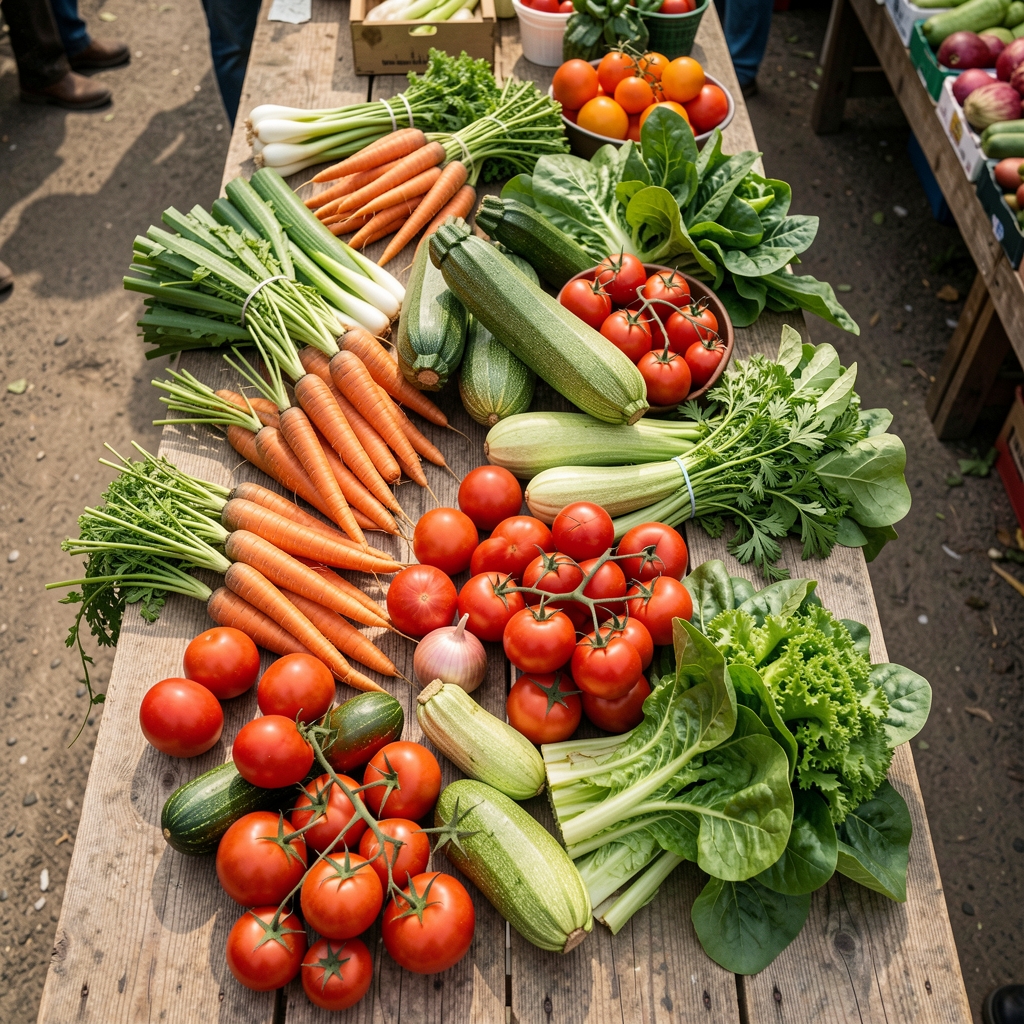
The structure of a weekly meal plan is, in essence, a record of available attention. It reflects the produce that appeared at the market on Saturday morning, the grain that remained in the cupboard from last week, and the hour set aside — or not set aside — on Sunday afternoon to bring those materials into some organised form. Seasonality, in this context, is not an aesthetic preference. It is a structural constraint that, when worked with rather than against, simplifies the planning process considerably and brings measurable gains in dietary variety across the week.
The Structural Case for Seasonal Sourcing
Much of the friction in weekly meal planning originates from the attempt to build menus around a fixed repertoire regardless of what is abundant and affordable. The summer salad assembled in January, the roasted squash soup pursued in July — these are not failures of ambition but failures of calendar alignment. When produce is sourced according to what the UK growing season makes plentiful, the planning process contracts. There are fewer decisions to make, because the decision has already been made by the season itself.
Research published in peer-reviewed nutrition journals consistently finds that dietary diversity — measured by the number of distinct plant foods consumed across a seven-day period — correlates positively with gut microbiome richness. Seasonal rotation of produce is one of the most natural mechanisms for achieving that diversity, because it enforces variety at the source rather than at the level of individual willpower. The person who shops seasonally in February encounters celeriac, purple sprouting broccoli, forced rhubarb, and stored root vegetables; the same person in July works with courgettes, runner beans, heritage tomatoes, and fresh herbs. These are not overlapping ingredient sets.
The practical consequence is a year-round rotation of phytonutrients, fibre types, and flavour profiles that a fixed menu cannot produce. Dietary fibre density — the grams of fibre per 1,000 kilocalories consumed — tends to be higher in seasonal whole-food menus because seasonal produce skews toward vegetables and legumes rather than the processed convenience items that fill gaps when fresh options feel limited.
Constructing the Weekly Framework
A functional weekly meal plan does not require granular hour-by-hour scheduling. It requires three structural decisions: the anchor proteins or legumes for the week, the dominant vegetable category available by season, and the grain or starchy base that will carry those components. Everything else — the spice profile, the cooking method, the portion arrangement — is secondary.
In practice, this means a Saturday market visit or a single online grocery order is the primary planning event of the week. The editorial team at Marlin Journal has observed, in conversations with contributors who write on food practice, that the most consistent home cooks typically hold to a five-item mental framework: one pulse, one leafy green, one root vegetable, one grain, and one protein anchor. Variations within each category are unlimited; the framework simply ensures that the week's shopping covers all macronutrient and fibre bases without reference to a formal checklist.
"The most consistent home cooks typically hold to a five-item mental framework: one pulse, one leafy green, one root vegetable, one grain, and one protein anchor."
The grain component deserves particular attention because it is the element most frequently substituted for a refined alternative. Whole grains — brown rice, farro, pearl barley, buckwheat, whole oats — carry substantially more fibre per serving than their refined counterparts and contribute a slow-release energy profile that affects how full a meal feels two hours after eating. For readers managing their weight through portion calibration and energy balance, swapping refined grains for whole-grain equivalents represents one of the highest-impact single changes that does not require a structural overhaul of the weekly plan.
Mapping Seasonal Windows to UK Produce
The United Kingdom's produce calendar operates across four reasonably distinct phases, each with its own planning logic. The winter months — November through February — are the season of storage crops: parsnips, celeriac, swede, kale, leeks, and the dried legumes and grains that carry nutritional density without freshness dependency. The transitional spring months bring forced chicory, wild garlic, asparagus from late April, new season potatoes, and early salad leaves. Summer is the period of maximum variety: broad beans, peas, courgettes, sweetcorn, heritage tomatoes, and an abundance of herbs. Autumn contracts variety somewhat but brings substantial brassica availability alongside the squash and pumpkin family, and the apple and pear harvest which, when kept whole and consumed as part of a meal rather than juiced, contributes meaningfully to daily fibre intake.
Each of these phases maps to a distinct flavour register, which in turn suggests different cooking approaches. Winter root vegetables favour long, slow application of dry heat — roasting, braising, slow-simmering. Spring produce favours brief steaming or raw application. Summer vegetables are highly versatile: effective raw, lightly dressed, or rapidly cooked over high heat. Autumn invites the first soups and warming grain salads of the year. Understanding these natural correspondences makes the selection of cooking method as automatic as the selection of ingredient.
Portion Architecture and Plate Composition
The concept of portion calibration — the deliberate arrangement of plate components to achieve a target macronutrient ratio — is sometimes presented as a numerically intensive practice. In reality, the foundational version requires nothing more than a visual heuristic: half the plate in non-starchy vegetables, a quarter in whole grain or starchy vegetable, a quarter in protein. This is not a rigid template but a spatial prompt. The person who follows it consistently over weeks is building a whole-food dietary pattern without counting a single calorie.
Seasonal whole-food menus align naturally with this composition principle. A winter bowl of lentil soup over pearl barley with kale and a spoon of tahini satisfies the visual heuristic without calculation. A summer plate of grilled courgettes, heritage tomatoes, and white beans with brown rice does the same. The seasonal rotation of primary ingredients means the palate is engaged across variety while the nutritional architecture remains consistent.
The Food Journal as a Planning Tool
A food journal — even a brief and informal one — serves a different function than a food diary used for numerical tracking. Rather than recording quantities consumed for analysis, a planning-oriented journal notes what worked and what did not in the previous week's meals: which combinations were appealing enough to return to, which were abandoned, and what gaps emerged between planned and actual consumption. This retrospective function transforms the journal into a feedback mechanism that improves the quality of the following week's plan without requiring daily attention.
Marlin Journal contributors who write on food practice frequently note that the single most effective intervention for improving dietary consistency is this brief weekly review. It takes approximately ten minutes and converts the meal plan from a wish list into a learning document. Over a twelve-week period, the cumulative effect of those ten-minute reviews is a highly personalised meal-planning template that reflects actual behaviour rather than aspirational behaviour.
Hydration as Structural Context
No examination of the weekly meal plan is complete without acknowledging the role of hydration in the function of whole-food nutrition. Dietary fibre — particularly the soluble fibre from oats, legumes, and seasonal root vegetables — requires adequate fluid intake to perform its role in the digestive process. The UK government's daily fluid intake guidance of approximately six to eight glasses of water or equivalent applies specifically to adults consuming the kind of fibre-rich whole-food diets this publication advocates.
In practice, the simplest hydration habit that supports a whole-food eating pattern is keeping water consistently visible and accessible throughout the day. Hydration is not a dramatic intervention. It is a background condition that affects how well the rest of the dietary framework functions. A well-constructed weekly meal plan that neglects hydration is structurally incomplete.
- ▪ Seasonal sourcing reduces planning friction and enforces dietary variety without requiring conscious effort at the menu-building stage.
- ▪ A five-item mental framework (pulse, leafy green, root vegetable, grain, protein anchor) covers all macronutrient and fibre bases for the week.
- ▪ Whole grains replace refined equivalents at equivalent cost and substantially higher fibre density per serving.
- ▪ A brief weekly ten-minute food journal review converts aspiration into a learning document that improves subsequent planning cycles.
- ▪ Adequate hydration is a structural prerequisite for fibre-rich whole-food diets to function as intended.